THREE:These various lathes, although of a widely varied construction and adapted to uses more or less dissimilar, are still the engine lathe either with some of its functions omitted to simplify and adapt it to some special work, or with some of the operative parts compounded to attain greater capacity.But the shell-fire of the French overtook them then, as they were retreating, while many others were killed by bombs from French aeroplanes, which were in action in great numbers. The retreat had not stopped before the Germans arrived in Cambray, where the thousands of wounded could at last be put in long trains and sent to Aix-la-Chapelle. A great many bombs from aeroplanes also hit these trains and killed a great many; my own train was everywhere pierced by fragments of those bombs. Within the carriages it was unendurable; the wounded men and their malodorous bandages had occupied them such a long time that the atmosphere was simply insupportable. Happily there was a corridor, where I stood all the time, with the little girl, in the company of some German military men who were sent home, not on account of wounds, but because of internal complaints.
FORE:A similar vein of thought runs through the moral and religious philosophy of Lucretius. If we look on him as a reformer, we shall say that his object was to free life from the delusions with which it had been disfigured by ignorance and passion. If we look on him as an artist, we shall say that he instinctively sought to represent life in the pure and perfect beauty of its naked form. If we look on him as a poet, we shall say that he exhibits all the objects of false belief no longer in the independence of their fancied reality, but in their place among other vital phenomena, and in due subordination112 to the human consciousness whose power, even when it is bound by them, they reveal. But while the first alternative leaves him in the position of a mere imitator or expositor who brings home no lessons that Epicurus had not already enforced with far greater success, the other two, and above all the last, restore him to the position of an original genius, who, instead of deriving his intuitions from the Epicurean system, adopts just so much of that system as is necessary to give them coherence and shape. It may, no doubt, be urged, that were life reduced to the simple expression, the state of almost vegetative repose, demanded by Lucretius, denuded of love, of ambition, of artistic luxury, of that aspiration towards belief in and union with some central soul of things, which all religions, more or less distinctly embody, its value for imaginative purposes would be destroyed; and that the deepest lesson taught by his poem would not be how to enjoy existence with the greatest intensity, but how to abandon it with the least regret. Now it is just here that the wonderful power of poetry comes in, and does for once, under the form of a general exposition, what it has to do again and again under the easier conditions of individual presentation. For poetry is essentially tragic, and almost always excites the activity of our imagination, not by giving it the assured possession of realities, but by the strain resulting from their actual or their expected eclipse. If Homer and the Attic tragedians show us what is life, and what are the goods of life, it is not through experience of the things themselves, but through the form of the void and the outline of the shadow which their removal or obscuration has produced. So also in the universal tragedy of the Roman poet, where the actors are not persons, but ideas. Every belief is felt with more poignant intensity at the moment of its overthrow, and the world of illusion is compensated for intellectual extinction by imaginative persistence as a conscious creation, a memory, or a dream. There is no mythological picture so splendidly painted as those in which Lucretius has shown us Mavors113 pillowed on the lap of Venus, or led before us the Idaean mother in her triumphal car. No redeemer, credited with supernatural powers, has ever enjoyed such an apotheosis as that bestowed by his worshipper on the apostle of unbelief. Nowhere have the terrible and mysterious suggestions of mortality been marshalled with such effect as in the argument showing that death no more admits of experience than of escape. What love-inspired poet has ever followed the storm and stress of passion with such tenderness of sympathy or such audacity of disclosure, as he to whom its objects were disrobed of their divinity, for whom its fancied satisfaction was but the kindling to insaner effort of a fatally unquenchable desire? Instead of being ¡®compelled to teach a truth he would not learn,¡¯ Lucretius was enabled by the spirit of his own incomparable art to seize and fix for ever, in bold reversal of light and shade, those visions on which the killing light of truth had long before him already dawned.The scepticism of Protagoras went beyond theology and extended to all science whatever. Such, at least, seems to have been the force of his celebrated declaration that ¡®man is the measure of all things, both as regards their existence and their non-existence.¡¯67 According to Plato, this doctrine followed from the identification of knowledge with sensible perception, which in its turn was based on a modified form of the Heracleitean theory of a perpetual flux. The series of external changes which constitutes Nature, acting on the series of internal changes which constitutes each man¡¯s personality, produces particular sensations, and these alone are the true reality. They vary with every variation in the88 factors, and therefore are not the same for separate individuals. Each man¡¯s perceptions are true for himself, but for himself alone. Plato easily shows that such a theory of truth is at variance with ordinary opinion, and that if all opinions are true, it must necessarily stand self-condemned. We may also observe that if nothing can be known but sensation, nothing can be known of its conditions. It would, however, be unfair to convict Protagoras of talking nonsense on the unsupported authority of the Theaet¨ºtus. Plato himself suggests that a better case might have been made out for the incriminated doctrine could its author have been heard in self-defence. We may conjecture that Protagoras did not distinguish very accurately between existence, knowledge, and applicability to practice. If we assume, what there seems good reason to believe, that in the great controversy of Nature versus Law, Protagoras sided with the latter, his position will at once become clear. When the champions of Nature credited her with a stability and an authority greater than could be claimed for merely human arrangements, it was a judicious step to carry the war into their territory, and ask, on what foundation then does Nature herself stand? Is not she, too, perpetually changing, and do we not become acquainted with her entirely through our own feelings? Ought not those feelings to be taken as the ultimate standard in all questions of right and wrong? Individual opinion is a fact which must be reckoned with, but which can be changed by persuasion, not by appeals to something that we none of us know anything about. Man is the measure of all things, not the will of gods whose very existence is uncertain, nor yet a purely hypothetical state of Nature. Human interests must take precedence of every other consideration. Hector meant nothing else when he preferred the obvious dictates of patriotism to inferences drawn from the flight of birds.
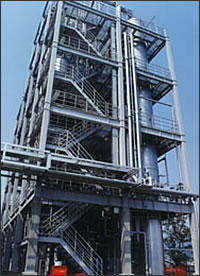
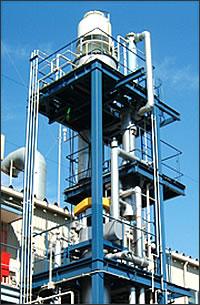
Methanol refinement systems, amyl alcohol refinement systems, ethanol refinement systems, hexanol distillation systems, propanol refinement systems, cyclohexanol distillation systems, isopropanol dehydration systems, ethylene glycol recovery systems, and butanol distillation systems.
FORE:It is never enough to know that any piece of work is commonly constructed in some particular manner, or that a proposition is generally accepted as being correct; a reason should be sought for. Nothing is learned, in the true sense, until the reasons for it are understood, and it is by no means sufficient to know from observation alone that belts are best for high speeds, that gearing is the best means of forming angles in transmitting power, or that gearing consumes more power, and that belts produce less jar and noise; the principles which lie at the bottom must be reached before it can be assumed that the matter is fairly understood.
Hexane distillation systems, tall oil distillation systems, benzene distillation systems, lubricating oil refinement systems, xylene-free distillation systems, low-boiling gas distillation systems, ethylbenzene recovery systems, fusel oil distillation systems, naphthalene distillation systems, propylene recovery systems, and turpentine oil distillation systems.
FORE:Whether Plato ever succeeded in making the idea of Good quite clear to others, or even to himself, is more than we can tell. In the Republic he declines giving further explanations on the ground that his pupils have not passed through the necessary mathematical initiation. Whether quantitative reasoning was to furnish the form or the matter of transcendent dialectic is left undetermined. We are told that on one occasion a large audience assembled to hear Plato lecture on229 the Good, but that, much to their disappointment, the discourse was entirely filled with geometrical and astronomical investigations. Bearing in mind, however, that mathematical science deals chiefly with equations, and that astronomy, according to Plato, had for its object to prove the absolute uniformity of the celestial motions, we may perhaps conclude that the idea of Good meant no more than the abstract notion of identity or indistinguishable likeness. The more complex idea of law as a uniformity of relations, whether coexistent or successive, had not then dawned, but it has since been similarly employed to bring physics into harmony with ethics and logic.
Ether distillation systems, camphor distillation systems, epichlorohydrin distillation systems, aniline distillation systems, dioxane refinement systems, acetonitrile distillation systems, furfural refinement systems, formalin distillation systems, cyclohexane distillation systems, monoethanolamine rectification systems, polyglycol ether distillation systems, dimethylformamide recovery systems, acrylic glycol ether distillation systems, acrylonitrile refinement systems, acetone recovery systems, pyridine distillation systems, methyl ethyl ketone recovery systems, picoline distillation systems, methyl isobutyl ketone recovery systems, and acetaldehyde recovery systems.