THREE:General Cartaux arrived and took up his position in the villages around Toulon. He was reinforced by General Doppet, from the Rhone, and General Dugommier, from the Var; and the latter had in his corps-d'arm¨¦e a young lieutenant of artillery, who contained in his yet unknown person the very genius of war¡ªnamely, Napoleon Buonaparte. Cartaux was a man who had risen from the ranks; Doppet had been a physician in Savoy; and Dugommier was acting on a plan sent from the Convention. Buonaparte suggested what he thought a much superior plan. "All you need," he said, "is to send away the English; and to do that, you have only to sweep the harbour and the roadstead with your batteries. Drive away the[423] ships, and the troops will not remain. Take the promontory of La Grasse, which commands both the inner and outer harbour, and Toulon will be yours in a couple of days." On this promontory stood two forts, Equilette and Balaquier, which had been much strengthened by the English. It was resolved to assault these forts, and batteries opposite to them were erected by the French under Buonaparte's direction. After much desperate fighting, vast numbers of troops being pressed against the forts, that of Balaquier was taken. This gave the French such command of the inner harbour, that Lord Hood called a council of war, and showed the necessity of retiring with the fleet, and thus enabling the Royalists to escape, who would otherwise be exterminated by their merciless countrymen. This was agreed to, and it was resolved to maintain the different forts till the ships had cleared out. The Neapolitans behaved very ill, showing no regard for anything but their own safety. They held two forts¡ªone at Cape Lebrun, and the other at Cape Lesset; these, they said, they would surrender as soon as the enemy approached. They made haste to get their ships and men out of harbour, leaving all else to take care of themselves. The Spaniards and Piedmontese behaved in a much nobler manner. They assisted willingly all day in getting on board the Royalists¡ªmen, women, and children. All night the troops began to defile through a narrow sallyport to the boats under the guns of the fort La Malaga. This was happily effected; and then Sir Sidney Smith, who had recently arrived at Toulon, and had volunteered the perilous office of blowing up the powder-magazines, stores, arsenals, and the ships that could not be removed, began his operations. He succeeded in setting fire to the stores and about forty ships of war that were in the harbour.Puisaye's mission to London had been successful. Pitt was weak enough to fall into the plan of sending over the Emigrants in our ships¡ªas if any such force could do more against the Republican armies than create fresh miseries to all parties, and bring down worse vengeance on the unfortunate Vend¨¦ans and Bretons. Puisaye, with the aid of the Counts d'Hervilly, d'Hector, du Dresnay, Colonel Routhalier, and other Royalist officers, had mustered a most miscellaneous[446] body of three thousand Emigrants, most of whom had been soldiers, and who were accompanied by four hundred artillerymen of Toulon, commanded by Routhalier. Besides these men, of whom the Count d'Artois, for the time, gave the command to Puisaye, intending himself to follow, Puisaye carried over ten thousand pounds, furnished by the Count d'Artois, twenty-seven thousand muskets, six hundred barrels of gunpowder, uniforms for seventeen thousand infantry and four thousand cavalry, as well as provisions for three months. These troops and stores were, after many delays, conveyed in a little squadron of three ships of the line and six frigates, attended by transports, and commanded by Sir John Borlase Warren. They sailed from the Isle of Wight in the beginning of June, another squadron being sent to take up the Emigrant troops in the Channel Islands, and land them at St. Malo, where they were to co-operate with bodies of Chouans. These Chouans were smugglers and bandits, who had led a life of plunder, and had been easily collected into a sort of guerilla force, and their mode of warfare still bore a strong resemblance to their old habits. These men, under their different chiefs, had been excited by Puisaye to combine for a strong resistance to the Republicans. They were dressed in green coats and pantaloons, with red waistcoats. During his absence, Puisaye had deputed the chief command of the Chouan bands to the so-called Baron Cormatin, or Sieur D¨¦soteux, who had assumed the title of Baron de Cormatin from an estate of his wife's. Cormatin was a vain, weak man, and by no means trustworthy, being ready, at any moment, to supersede his chief, Puisaye, and act for himself. If the expedition against St. Malo did not succeed, it was to join Puisaye and his detachment in the Bay of Quiberon; and transports were also sent to the mouth of the Elbe, to fetch thence the Emigrant regiments with the black cockade, and bring them to join Puisaye. If all went well, the Count d'Artois was to follow with British troops. The grand error of the whole was, that the French prince did not put himself at once at the head of the expedition, and see the different squadrons united in the Bay of Quiberon before making the descent, though, even then, it could have effected no great success.
FORE:[See larger version]
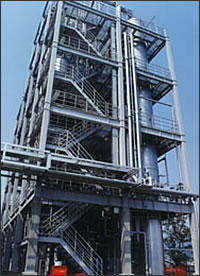
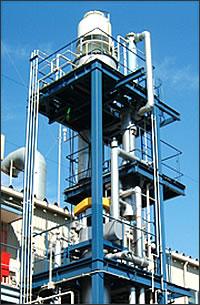
Methanol refinement systems, amyl alcohol refinement systems, ethanol refinement systems, hexanol distillation systems, propanol refinement systems, cyclohexanol distillation systems, isopropanol dehydration systems, ethylene glycol recovery systems, and butanol distillation systems.
FORE:On the 6th of November came down that fierce Russian winter of which Buonaparte had been so long vainly warned. A thick fog obscured everything, and snow falling in heavy flakes blinded and chilled the soldiers. Then commenced wild winds, driving the snow around their heads in whirls, and even dashing them to the earth in their fury. The hollows and ravines were speedily drifted full, and the soldiers by thousands disappeared in the deceitful depths, to reappear no more till the next summer revealed their corpses. Numbers of others fell exhausted by the way, and could only be discovered by their following comrades by the slight hillocks that their bodies made under the snow. Thus the wretched army struggled and stumbled to Smolensk, only to find famine and desolation, seeming to forget, in the mere name of a town, that it was now but a name, having been burnt by the Russians. On commencing this terrible march of the 6th of November Buonaparte received the ill news that there was insurrection in Paris¡ªthat produced by Mallet, but soon put down; and also that Wittgenstein had driven St. Cyr from Polotsk and Vitebsk, and reoccupied the whole course of the Düna. To clear his retreat of this obstruction, Buonaparte dispatched Victor to repulse Wittgenstein and support St. Cyr. But this was only part of the evil tidings which came in simultaneously with winter. Two thousand recruits from France, under Baraguay d'Hilliers, had been surprised and taken prisoners on the road to Kaluga, and other detachments in other quarters. On arriving at Smolensk Buonaparte's troops had acquired such a wild, haggard, and ragged appearance that the garrison at first refused to admit them; and many perished before they could be relieved from the stores. They had no shelter amid the terrible frost but wretched sheds, reared from half-burnt timber, against the fire-blackened walls.[See larger version]
Hexane distillation systems, tall oil distillation systems, benzene distillation systems, lubricating oil refinement systems, xylene-free distillation systems, low-boiling gas distillation systems, ethylbenzene recovery systems, fusel oil distillation systems, naphthalene distillation systems, propylene recovery systems, and turpentine oil distillation systems.
FORE:On the 9th of October the King of Prussia issued a manifesto from his headquarters at Erfurt, calling attention to the continual aggressions of France¡ªthose aggressions which Prussia had so long watched in profound apathy, and which, by timely union with Austria and Russia, might have been checked. But Prussia had, by her mean conduct, now stripped herself of all sympathy and all co-operation. She would have been very glad indeed of the money of Great Britain, but she had so far favoured the very aggressions of Buonaparte of which she now complained as to receive Hanover from him, and could not even now find it in her heart to surrender it, and make a powerful friend by that act of justice. The Emperor of Russia was willing to co-operate, but Prussia had made her hostile manifestations before Alexander could approach with his army. In reply to the intimations of Prussia, that she would be glad of the support of Britain, Lord Morpeth was sent to Berlin; but the language of the Prussian Ministry was still of the most selfish and impolitic character, and Lucchesini told Lord Morpeth that the fate of[526] Hanover must depend on the event of the coming war. With such a Power no union could take place, and in this isolated and pitiable condition Prussia was left to try her strength with Napoleon. As for that ambitious soldier, he desired nothing so much as this encounter with Prussia; he saw in it the only obstacle to his complete dominion over Germany, and he was confident that he should scatter her armies at the first shock.
Ether distillation systems, camphor distillation systems, epichlorohydrin distillation systems, aniline distillation systems, dioxane refinement systems, acetonitrile distillation systems, furfural refinement systems, formalin distillation systems, cyclohexane distillation systems, monoethanolamine rectification systems, polyglycol ether distillation systems, dimethylformamide recovery systems, acrylic glycol ether distillation systems, acrylonitrile refinement systems, acetone recovery systems, pyridine distillation systems, methyl ethyl ketone recovery systems, picoline distillation systems, methyl isobutyl ketone recovery systems, and acetaldehyde recovery systems.