TWO:There was an energetic debate in each House as the Bill passed through. It was opposed in the Peers by Lords Lansdowne, Holland, and Erskine, but was carried by ninety-three against twenty-seven. Ten peers entered a strong protest on the journals against the measure, denying the traitorous conspiracy or the extensive disaffection to the Government alleged, affirming that the execution of the ordinary laws would have been amply sufficient, and that Ministers were not entitled to indemnity for causeless arrests and long imprisonments which had taken place, for the Bill went to protect them in decidedly illegal acts. In the House of Commons the Bill was strongly opposed by Brougham, Tierney, Mr. Lambton¡ªafterwards Lord Durham¡ªand Sir Samuel Romilly. They condemned the conduct of Ministers in severe language, while the Bill was supported by Canning, by Mr. Lamb¡ªafterwards Lord Melbourne, who generally went with the other side¡ªby Sir William Garrow, and Sir Samuel Shepherd, Attorney-General.By the firmness of the Allies a peace which continued twelve years was given to Europe, and the storm which Alberoni had so fondly expected out of the North was as completely dissipated. The new Queen of Sweden had consented to yield absolutely to George I., as King of Hanover, the disputed possession of Bremen and Verden. Poland was induced to acknowledge Augustus of Saxony as king, and Prussia to be satisfied with the acquisition of Stettin and some other Swedish territory. But the Czar and the King of Denmark, seeing Sweden deprived of its military monarch, and exhausted by his wild campaigns, contemplated the actual dismemberment of Sweden. The Queen of Sweden threw herself for protection on the good offices of the King of England, and both England and France agreed to compel the Czar and the King of Denmark to desist from their attacks on Sweden if they would not listen to friendly mediation. Lord Carteret, a promising young statesman, was sent as ambassador to Stockholm, and Sir John Norris, with eleven sail of the line, was ordered to the Baltic. Russia and Denmark, however, continued to disregard the pacific overtures of England, trusting to there being no war with that Power. They ravaged the whole coast of Sweden, burning above a thousand villages, and the town of Nyk?ping, the third place in the kingdom. Seeing this, Lord Stanhope, who was still at Hanover with the king, sent orders to Admiral Norris to pay no regard to the fact of there being no declaration of war, but to treat the Russian and Danish fleet as[44] Byng had treated the Spanish one. Norris accordingly joined his squadron to the Swedish fleet at Carlscrona, and went in pursuit of the fleet of the Czar. Peter, seeing that the English were now in earnest, recalled his fleet with precipitation, and thereby, no doubt, saved it from complete destruction; but he still continued to refuse to make peace, and determined on the first opportunity to have a further slice of Swedish territory. Denmark, which was extremely poor, agreed to accept a sum of money in lieu of Marstrand, which it had seized; and thus all Europe, except the Czar, was brought to a condition of peace.
THREE:
FORE:Napoleon had so far executed his plans with wonderful success. He had rescued Bavaria, reduced the enemy's army and prestige at once by the capture of Ulm and Vienna, and had driven the Austrians simultaneously from Upper Italy and the Tyrol. But still his situation, for any general but himself, was very critical. The defeated army of the Emperor Francis had united itself to that of the young Emperor of Russia, in Moravia; the two archdukes were mustering great bodies of troops on the confines of Hungary, ready to rush forward and swell the Austro-Russian army; and the King of Prussia was watching the movements of the two parties, ready to strike, if France met with a reverse. Napoleon saw that his only security lay in a bold and decisive blow. He therefore crossed the Danube on the 23rd of November, and began a brisk march into the heart of Moravia, to attack the main body of the Allies under their two Emperors. He was soon before Brünn, its little capital, and the Allies retreated, at his approach, as far as Olmütz. This movement was, however, made to form a junction with the twenty-four thousand men under Benningsen. This being effected, they amounted to about eighty thousand men, but of these, many of the Austrians were troops already discouraged by defeat, and many more were raw recruits. The French were in number about equal, but consisting of veteran soldiers flushed with victory. On the 2nd of December Napoleon brought on the battle of Austerlitz, and before the close of the day the forces of the Coalition were completely beaten, losing upon the field some 27,000 killed and wounded, 20,000 prisoners, and 133 pieces of cannon.[97]
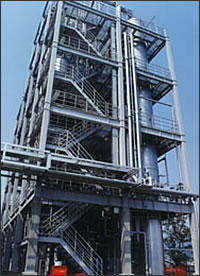
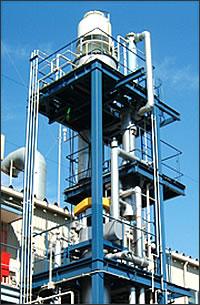
Methanol refinement systems, amyl alcohol refinement systems, ethanol refinement systems, hexanol distillation systems, propanol refinement systems, cyclohexanol distillation systems, isopropanol dehydration systems, ethylene glycol recovery systems, and butanol distillation systems.
FORE:"Now is the stately column broke,An effort was made to decide the long-agitated question of the emancipation of the Jews in the Session of 1849. On the 19th of February Lord John Russell moved that the House of Commons should go into committee for the purpose of considering the oaths taken by members of Parliament, excepting the Roman Catholic oath, settled in 1829. The oath of allegiance, he said, became a mockery when Cardinal York died, there being no descendants of James II. in existence; he therefore proposed to abolish it. The oath of abjuration, which was aimed against Papal aggression, had now no practical effect but to exclude the Jews from Parliament, which it did by the words "on the true faith of a Christian," which were never meant to exclude Jews, but only to give greater solemnity to the oath. He proposed, therefore, to omit these words when the oath was tendered to a Jew, and this he thought would complete the measure of religious liberty. The House resolved by a large majority¡ª214 to 111¡ªto go into committee on the subject. He then moved a resolution that it was expedient to alter the Parliamentary oaths so as "to make provision in respect of the said oaths for the relief of her Majesty's subjects professing the Jewish religion." A Bill founded on this resolution was brought in by Lord John Russell. The second reading was carried by a majority of 278 to 185. The third reading, after an important debate, was carried by a majority of 66. In the House of Lords the second reading was moved on the 26th of July, by the Earl of Carlisle, in an able speech, in which he observed that the Jews, though admitted to municipal privileges, were the only religious community debarred from political rights; but there was not, as far as he could see, a single valid objection upon which they could be refused. The Earl of Eglinton objected to their admission on religious grounds; so also did the Archbishop of Canterbury and the Bishop of Exeter. The former argued that our national Christianity, to which we owed our greatness, would be grievously disparaged by the measure. The latter condemned it as a violation of the distinct contract between the Sovereign and the nation¡ªthat the Crown should maintain "to the utmost the laws of God and the true profession of the Gospel." The Archbishop of Dublin (Whately), always the powerful champion of religious freedom,[603] contended on the other hand that it was inconsistent with the principles and repugnant to the genius of Christianity that civil disqualifications and penalties should be imposed on those who did not conform to it. Their lordships must either retrace their steps, and exclude from office all who did not belong to the Established Church, or they must, in consistency, consent to the abrogation of this last restriction. The Bill was rejected by a majority of 25¡ªthe numbers being, for the second reading, 70; against it, 95.
Hexane distillation systems, tall oil distillation systems, benzene distillation systems, lubricating oil refinement systems, xylene-free distillation systems, low-boiling gas distillation systems, ethylbenzene recovery systems, fusel oil distillation systems, naphthalene distillation systems, propylene recovery systems, and turpentine oil distillation systems.
FORE:[See larger version]
Ether distillation systems, camphor distillation systems, epichlorohydrin distillation systems, aniline distillation systems, dioxane refinement systems, acetonitrile distillation systems, furfural refinement systems, formalin distillation systems, cyclohexane distillation systems, monoethanolamine rectification systems, polyglycol ether distillation systems, dimethylformamide recovery systems, acrylic glycol ether distillation systems, acrylonitrile refinement systems, acetone recovery systems, pyridine distillation systems, methyl ethyl ketone recovery systems, picoline distillation systems, methyl isobutyl ketone recovery systems, and acetaldehyde recovery systems.
