TWO:The army of Joseph dispersed at full speed, and as our cavalry could not pursue them across the hedges and ditches, they managed to escape, and made their way to Pampeluna in one wild, chaotic herd. On the field they profess to have left eight thousand men in killed and wounded, but their loss was far greater. They left, also, one hundred and fifty-one pieces of brass ordnance, four hundred and fifteen caissons, more than forty thousand rounds of ammunition, nearly two million musketball cartridges, forty thousand six hundred and sixty-eight pounds of gunpowder, fifty-six forage[59] waggons, and forty-four forge waggons. The allied army had killed, British, five hundred and one; Portuguese, one hundred and fifty; Spaniards, only eighty-nine: wounded, British, two thousand eight hundred and seven; Portuguese, eight hundred and ninety-nine; Spanish, four hundred and sixty-four. Lord Wellington reported the conduct of almost every officer engaged as admirable. King Joseph did not stop till he was safe, for a time, within the strong walls of Pampeluna, but the garrison there would not admit the rabble herd of fugitives, but sent them off like enemies; and they were forced to continue their flight into the Pyrenees.On the 10th of September the Prussians began to examine the passes of the forest; and finding them defended, they attacked the French entrenchments but were everywhere repulsed. On the 11th, they concentrated their efforts on the pass of Grand-Pr¨¦, defended by Dumouriez himself, and were again repulsed by General Miranda at Mortaume, and by General Stengel at St. Jouvion. The Allies, thus unexpectedly brought to a check, for they had been led by the Emigrants to expect a disorganised or as yet undisciplined army, determined to skirt the forest and endeavour to turn it near Sedan. Whilst engaged in this plan, the Austrians discovered the weakness of the force in the defile of Croix-aux-Bois, where only two battalions and two squadrons of volunteers were posted, for Dumouriez had not examined the pass himself and was assured that this force was amply sufficient. Once aware of this mistake, the Austrians, under the Duke de Ligne, briskly attacked the position and drove the French before them. Dumouriez, informed of this disorder, ordered forward General Chasot with a strong force, who defeated the Austrians, killed De Ligne, and recovered the pass. But the advantage was but momentary; the Austrians returned to the charge with a far superior force, and again cleared the pass and remained in possession of it. Thus Dumouriez saw his grand plan of defence broken up; and finding that Chasot, who had fallen back on Vouziers, was cut off from him on his left along with Dubouquet, he saw the necessity of falling back himself into the rear of Dillon, on his right, who was yet master of the Islettes and the road to St. Menehould. He then sent messages to Chasot, Dubouquet, and to Kellermann, to direct their march so as to meet him at St. Menehould.
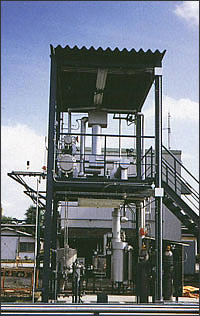
Great attention is recently being paid to global environmental issues, and it is now conceivable that companies will need to treat used solvents themselves. In consideration of this kind of social issue, we have developed a “membrane separation type solvent dehydration system,” which uses a polyimide membrane with superior dehydration properties developed by Ube Industries, Ltd. in combination with our own distillation and concentration technology that has resulted in solvents being more easily recovered.
THREE:But Joseph did not live to see the full extent of the alienation of the Netherlands. He had despatched Count Cobentzel to Brussels on the failure of Trautmansdorff's efforts. Cobentzel was an able diplomatist, but all his offers were treated with indifference. On the last day of 1789 the States of Brabant, in presence of the citizens of Brussels, swore to stand by their new freedom¡ªan act which was received by the acclamations of the assembled crowds. They soon afterwards ratified their league with the other States, and entered into active negotiation with the revolutionists of France for mutual defence. On the 20th of February, 1790, Joseph expired, leaving a prospect full of trouble to his brother Leopold, the new Emperor.
- 1Under the distillation system, even in case of azeotropic solvent compositions, this system which remove water vapor by the polyimide membrane will easily dehydrate.
- 2In comparison with the distillation system, it significantly saves on use of steam.
- 3Dehydration can be performed through merely supplying evaporated vapor to the membrane module and maintaining the differential pressure between the permeable side and the impermeable side.
- 4Solvent purity of 99.9% or more can be achieved by carrying out dehydration with a polyimide membrane only.
- 5The polyimide membrane has superior heat and solvent resistance. Therefore, the vapor permeation system reduces contamination of the membrane and thus extends its life.
THREE:
The aromatic polyimide membrane is highly permeable to water vapor but less permeable to vapors of organic compounds such as alcohol etc.
THREE:At Calcutta, Francis, Clavering, and Monson were deeply engaged in what appeared to them a certain plan for the ruin of Hastings. The Maharajah Nuncomar, who styled himself the head of the Brahmins, came forward and laid before them papers containing the most awful charges against Hastings. These were that Hastings had encouraged him, at the command of the Secret Committee, to produce charges against Mohammed Rheza Khan and Shitab Roy, when they were in prison, in order to extort money from them; and that Hastings had accepted a heavy bribe to allow Mohammed to escape without punishment. Hastings broke up the Council, declaring that he would not sit to be judged by his own Council. If they had charges to prefer against him, they might form themselves into a committee, and transmit such evidence as they received to the Supreme Court of Justice at Calcutta, or to the Directors at home. But the three declared themselves a majority, voted their own competence to sit and try their own chief, and preferred another huge charge introduced by Nuncomar¡ªnamely, that Hastings had appropriated to[327] himself two-thirds of the salary of the Governor of Hooghly, a post formerly held by Nuncomar himself. They determined to introduce Nuncomar to confront Hastings at his own Council board. Hastings declared the Council not sitting; the three declared it sitting and valid, and called in Nuncomar, who proceeded to detail his charges, and ended by producing a letter from the Munny Begum, now Governor of Oude, expressing the gratitude which she felt to the Governor-General for her appointment as guardian of the Nabob, and that in token of this gratitude she had presented him with two lacs of rupees. Immediately on hearing that, Hastings declared the letter a forgery, and that he would prove it so; and he was not long in procuring an absolute denial of the letter from the Begum. Things being driven to this pass, Hastings commenced an action against Nuncomar, Mr. Fowke, one of the most active agents of the trio, and others, as guilty of a conspiracy against him. This was supported by native witnesses, and the Supreme Court of Justice, after a long and careful examination of the case, held Nuncomar and Fowke to bail, and bound the Governor-General to prosecute.Wellington proceeded to put Badajoz into a strong state of defence, but he was soon called off by the movements of Marmont, who, in his absence, had advanced and invested both Ciudad Rodrigo and Almeida. Wellington left General Hill to watch the south, which was the more necessary as Soult was in strong force at Seville, and Victor before Cadiz. That general had made a vigorous attack on Tarifa towards the end of December, but was repulsed with much loss by Colonel Skerrett. Hill, who had about twelve thousand men, made a successful attack on some strong forts near Almaraz, on the Tagus, erected by the French to protect their bridge of boats there¡ªthus closing the communication between Soult in the south and Marmont in the north. In these satisfactory circumstances, Wellington[27] broke up his cantonments between the Coa and the Agueda on the 13th of June, and commenced his march into Spain with about forty thousand men. Of these, however, one column consisted of Spaniards, on whom he wisely placed little reliance, and his cavalry was small and indifferently officered in comparison with the infantry. Marmont had as many infantry as himself, and a much more numerous and better disciplined cavalry. As Wellington advanced, too, he learned that General Bonnet, with a force upwards of six thousand strong, was hastening to support Marmont. That general abandoned Salamanca as Wellington approached, and on the 17th the British army entered the city, to the great joy of the people, who, during the three years which the French had held it, had suffered inconceivable miseries and insults; not the least of these was to see the usurper destroy twenty-two of the twenty-five colleges in this famous seat of learning, and thirteen out of twenty-five convents. Troops were left in different forts, both in the city and by the bridge over the river Tormes, which forts had chiefly been constructed out of the materials of the schools and monasteries. These were soon compelled to surrender, but not without heavy loss. Major Bowes and one hundred and twenty men fell in carrying those by the bridge. After different man?uvres, Marmont showed himself on the British right, near San Christoval, where he was met by a division under Sir Thomas Graham, who had beaten the French at Barrosa. Fresh man?uvres then took place: Marmont crossing and recrossing the Douro, and marching along its banks, to cut off Wellington from his forces in Salamanca, and to enable himself to open the way for King Joseph's troops from Madrid. This being accomplished, and being joined by General Bonnet, he faced the army of Wellington on the Guare?a. On the 20th of July he crossed that river, and there was a rapid movement of both armies, each trying to prevent the other from cutting off the way to Salamanca and Ciudad Rodrigo. On that day both armies were seen marching parallel to each other, and now and then exchanging cannon-shots. The military authorities present there describe the scene of those two rival armies¡ªmaking a total of ninety thousand men, and each displaying all the splendour and discipline of arms, each general intent on taking the other at some disadvantage¡ªas one of the finest spectacles ever seen in warfare. The next day both generals crossed the river Tormes¡ªWellington by the bridge in his possession, the French by fords higher up. They were now in front of Salamanca, Marmont still man?uvring to cut off the road to Ciudad Rodrigo. On the morning of the 22nd Marmont, favoured by some woods, gained some advantage in that direction; but Wellington drew up his troops in great strength behind the village of Arapiles, and Marmont extending his left to turn the British right flank, Wellington suddenly made a desperate dash at his line, and cut it in two. Marmont's left was quickly beaten on the heights that he had occupied, and was driven down them at the point of the bayonet. Marmont was so severely wounded that he was compelled to quit the field, and give up the command to Bonnet; but Bonnet was soon wounded too, and obliged to surrender the command to General Clausel, who had just arrived with reinforcements from "the army of the north," of which Wellington had had information, and which induced him to give battle before he could bring up all his force. Clausel reformed the line, and made a terrible attack on the British with his artillery; but Wellington charged again, though the fight was up hill; drove the French from their heights with the bayonet once more, and sent them in full rout through the woods towards the Tormes. They were sharply pursued by the infantry, under General Anson, and the cavalry, under Sir Stapleton Cotton, till the night stopped them. But at dawn the same troops again pursued them, supported by more horse; and overtaking the enemy's rear at La Serna, they drove it in¡ªthe cavalry putting spurs to their horses, and leaving the foot to their fate. Three battalions of these were made prisoners. As the French fled, they encountered the main body of Clausel's army of the north, but these turned and fled too; and on the night of the 23rd the fugitives had reached Flores de Avila, thirty miles from the field of battle. The flight and pursuit were continued all the way from Salamanca to Valladolid.
- 1 Recovery of the detergent solvent Recovery of the cleaning solvent such as electronic parts industry, precision instrument industry.
- 2Solvent recovery and the refinement Solvent recovery and the refinement such as chemical industry, an industry of medical supplies, food industry, the fermentation industry.
THREE:
Acetone, ethanol, methyl ethyl ketone, butanol, isopropyl alcohol, ethyl acetate, methyl isobutyl ketone, others (including hexane and toluene).
